We can't have nice things
The recurring phrase "This is why we can't have nice things" struck me harder than what I would like. It is just a meme, used to assign blame to Y, for the state of affairs of X. A meme that became a song. But there is something about it that bothers me deeply: we actually can not have nice things. Usually.
This is why:
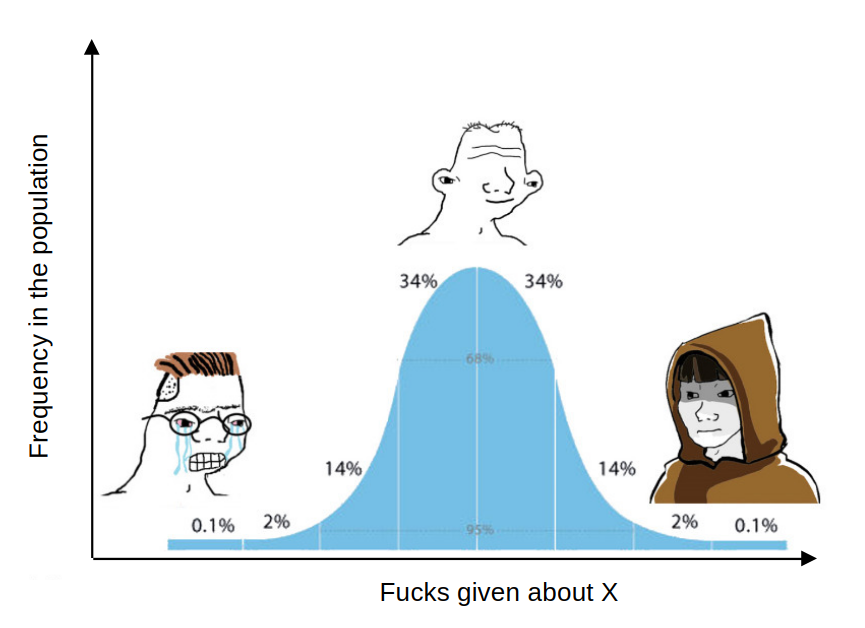
For every X thing in our complex world, there is a small group of individuals that deeply care about it - The Boutique; there is another small group of individuals that rather see it as something to exploit - The Crooks; and there is a very large group of individuals that cares to a certain extent but not to the point of keeping it in shape - The Normies. In other words, the level of individual concern for X follows something like a Normal Distribution.
I know. This is a simplification in the lines of let that cow be a sphere. But let me make an argument.
X is nice in the beginning, as it is driven by The Boutique. Once The Normies realize X is nice, they gradually adopt it, pushing The Boutique, as time goes by, to a position of lower influence. Once The Crooks realize The Normies are onboard they find ways to exploit their naivety for short-term profit. Then either X ends up destroyed by The Crooks or heavily damaged by the countermeasures put in place by The Boutique and The Normies, while trying to rescue X. Either way the nice phase of X is gone for good.
I should note that The Normies tend to ruin nice things not out of malice, but through indifference and lack of concern. They demand convenience over consistency and discipline, creating a context that The Crooks exploit.
The more X depends on network effects, the more reality aligns with this theory.
We are all in The Boutique for a couple of things and in The Normies group for most other things. Whether you are a CEO imposing Azure on your technical team, a CFO forbidding Capex, an end user demanding Spotify on a work computer or a wedding-DJ playing reggaeton - nobody is innocent in this game.
My former accountant was never worried about browser monopolies - his ERP software was so inefficient that being forced to use Internet Explorer was the least of his concerns. And I was never an accounting standards zealot - he knew accounting in detail and I simply trusted he would follow the right standards. Perhaps other accountants were sloppy and he wasn't. For me, boutique accounting was not on top of mind - accounting was a practical issue. For him, boutique internet standards were not critical - a somewhat working browser was a practical concern.
This is why we can't have nice things.
You might think I am dramatizing. Let me present some depressing tech-facts from 2026, the year where the AI revolution is everywhere in the news:
- email usability sucks / email maintenance sucks too
- we still can't interoperate "office" documents across systems without frequent formatting problems
- a single HTML rendering engine (Blink/Chromium) controls nearly 80% of the web
- software engineering follows hype cycles rather than engineering principles
- Devops are dead and buried
- social networks are full of culture wars, garbage, misinformation and political manipulation
These things used to be nice or, at least, were improving at some point. Until they weren't.
Let's pick the first point.
Email was nice during the 90s and early 2000s. Terminal-based email clients were fast. Graphical email clients implemented threading and understood quotation symbols. Attachments were attachments. Complex software projects were often managed over email. People used email to communicate to peers across the globe: for the sake of science, engineering, commerce and friendship. By then, there were many different software options built on open standards (SMTP, POP, IMAP) that allowed for distributed management of email systems and personal choice in regards to clients. That was the boutique period.
Here is a screenshot from the Suse wiki showing deep threads and quoting, both perfectly handled by KMail:

What happened next:
- HTML crept into email, but obviously the half-baked HTML in use would not work correctly across different email clients
- attachment images and inline images got mixed up; users would not understand the difference, email clients struggled to render
- people started using email messages as attachments to other email messages
- stupid Winmail.dat became a thing
- stupid non-standard protocols from Microsoft Exchange prevented network interoperability
- Outlook broke email threading and quoting to the point of those email capabilities being forgotten
- Google had the opportunity to redo email usability with GMail but, despite it being faster than Office 365, the overall usability is still not great and the implementation of "conversations" is terrible
This series of events turned what used to be a peaceful and interoperable communication experience into an email client incompatibility nightmare. I understand that large corporations needed pink highlights in the message body, along with underlining and Comic Sans. Home users, on the other hand, needed cat pictures on the email signature. But at what cost, if I may?
As this was happening The Crooks realized that email was now being heavily used by The Normies. That opened an entire blue ocean for SPAM, commercial scams and security hacks. The Normies click on every .EXE or office document sent by email. They click on every link too. And if something takes time to react, they simply click further.
As non-legitimate emails became dominant, inboxes were flooded and security hacks piled up. Countermeasures had to be put in place: SPAM classifiers, SPF, DKIM, gray listing, rate limiting, blocking of all "residential" network blocks, third-party blacklists, server-side virus scanning... The necessary effort to run email systems became so high that today only a handful of providers can handle it. Once this level of concentration was reached, poor interoperability stepped in - we live now in deliverability hell for smaller providers. A large email provider can afford to let your legitimate emails sink into a black hole, giving no explanations. It might react if another entire large provider is unable deliver but small providers are left with trial and error. This is a huge incentive for concentration - we should not expect more competition on the email front. Thus, it is not likely that usability will improve.
How can I be so confident about this? I managed email servers and supported business users for around 18 years. I am not alone, by the way. To illustrate how far the email oligopoly situation is accepted, this is how Slack, a normie company that lacks the resources to make video calls work on Firefox, sees email:
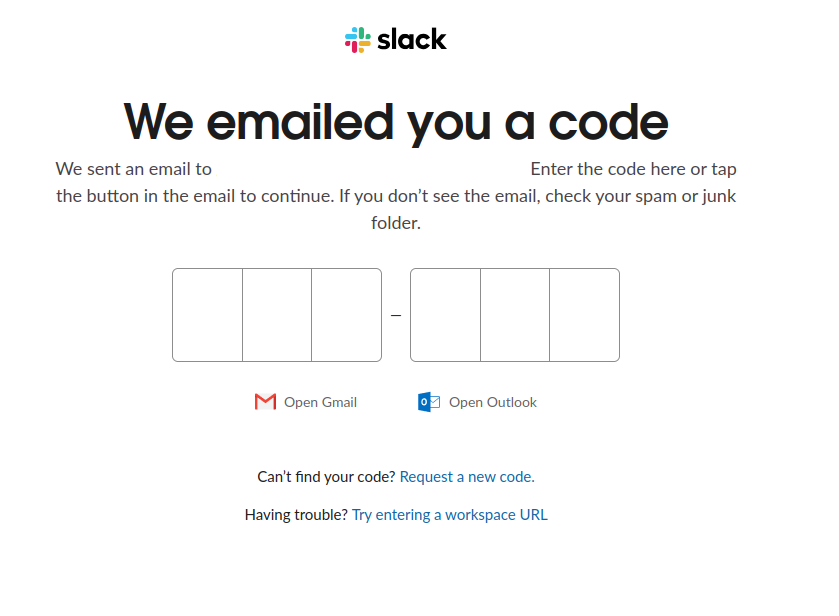
From this point on, there is no way back. Email - a protocol built on Open Standards by Internet pioneers - is effectively controlled by Crooks and Normies. Because email now sucks, it is used less frequently than before, most of the communication happening inside the walled gardens of messaging apps like Slack, Whatsapp or Teams. And for messaging apps we see mixed usability, no interoperability and no Open Standards, not to mention the obvious privacy issues. The Commons have been tragically defeated, organically and without an external enemy.
From here, it would be tempting to review the entire OOXML debacle (point 2) and draw the parallels. That was another case where a boutique standards group working on long-term interoperability for the Commons was overrun by a coalition of Normies pressed by their short-term agendas, under dubious incentives by some Crooks. Finding out who is who in the OOXML saga is left as an exercise for the reader. Investigating points 3-6 is additional homework. Bonus points for checking whether or not the Internet is now mostly ads and slop.
Last point: one might naturally wonder, so how come Wikipedia did not collapse as it became popular? The answer lies in differentiating "scale of consumption" and "scale of participation/influence". While reading Wikipedia is popular for consumption, being a Wikipedia editor remains a niche activity.
Can something be done?
I will say that one way to keep having nice things is to find a business that can be both sustained by The Boutique and managed by The Boutique. B2B as in boutique to boutique, whatever your boutique of choice. Another way might be to prevent consumption from determining governance. Linux, for instance, which reached the hands of the masses via Android smartphones, is famous for living under the tight grip of a bad-tempered BDFL. And there is HTMX: they invite everybody to be the CEO, but in the end it's good old Carson Gross doing most of the work, while promising "no new features as a feature".
Jokes aside, I remain pessimistic: there are few nice things left and all of them are constantly under pressure. Those who care will have to find their own bubble. Where is yours?